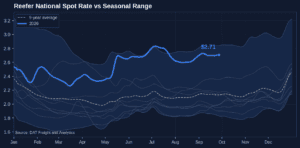
Reefer Report: Rates ease as produce rush cools, but the year-over-year premium holds
Reefer spot linehaul rates paid to carriers averaged $2.71 per mile last week, minus fuel, down 0.7%, or $0.02 per
Reefer spot linehaul rates paid to carriers averaged $2.71 per mile last week, minus fuel, down 0.7%, or $0.02 per
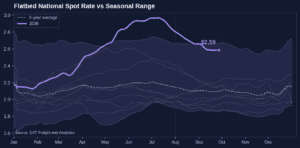
Flatbed spot linehaul rates paid to carriers averaged $2.59 per mile last week, minus fuel, down 0.5%, or $0.01 per mile, from the week before.
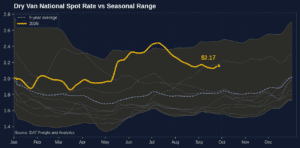
Dry van spot linehaul rates paid to carriers averaged $2.17 per mile last week, minus fuel, unchanged from the week before.
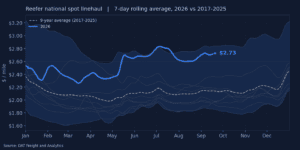
Reefer spot linehaul averaged $2.73 per mile last week, minus fuel, up 0.7%, or $0.02 per mile, from the week before.

Where to get the data, what a Gulf landfall does to a routing guide, and how to price a bid from the shipper’s side of the transaction.
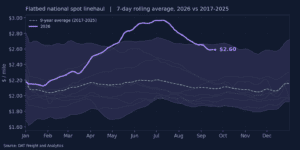
Flatbed spot linehaul paid to carriers averaged $2.60 per mile last week, minus fuel, down 0.5%, or $0.01 per mile, from the week before.
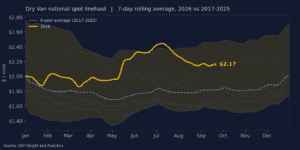
Dry van spot linehaul rates paid to carriers averaged $2.17 per mile last week, minus fuel, down 1.2%, or $0.03 per mile, from the week before.
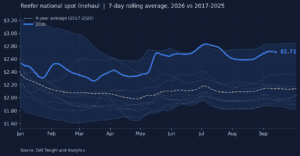
Reefer spot linehaul rates paid to carriers averaged $2.71 per mile last week, minus fuel, down 0.8%, or $0.02 per mile, from the week before.
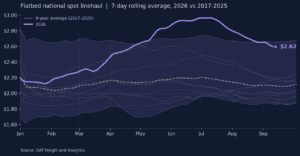
Flatbed spot linehaul rates paid to carriers averaged $2.62 per mile last week, minus fuel, down 1.8%, or $0.05 per mile, from the week before.

DAT Trendlines has a new look and a lot more to show you.

The data backs up what most brokers already feel: Fraud activity climbs in the fall and keeps climbing into the holidays.
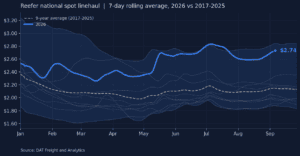
Reefer spot linehaul rates paid to carriers averaged $2.74 per mile this week, minus fuel, up 1.9%, or $0.05 per mile, from the prior week.