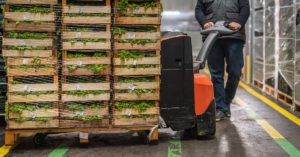
A carrier’s guide to produce shipping season
You don’t have to be hauling food to feel the effects of produce season. It’s when demand for trucks is near its highest. And when demand rises, rates follow.
You don’t have to be hauling food to feel the effects of produce season. It’s when demand for trucks is near its highest. And when demand rises, rates follow.
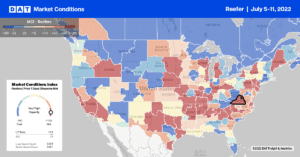
While overall produce volumes are down just under 15% this season, carriers hauling fruit and vegetables out of major growing regions into major capital cities are having a great year.

The DAT iQ analytics team takes a weekly look at how the freight markets are responding to the COVID-19 crisis,
Got reefers? It’s time to move ’em on down to produce markets in the Southern states. Spring is finally here.
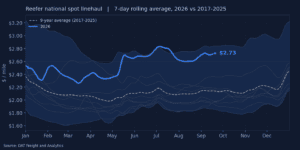
Reefer spot linehaul averaged $2.73 per mile last week, minus fuel, up 0.7%, or $0.02 per mile, from the week before.
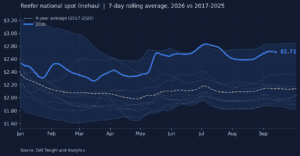
Reefer spot linehaul rates paid to carriers averaged $2.71 per mile last week, minus fuel, down 0.8%, or $0.02 per mile, from the week before.
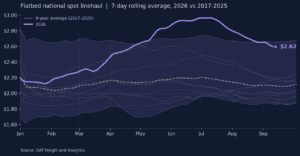
Flatbed spot linehaul rates paid to carriers averaged $2.62 per mile last week, minus fuel, down 1.8%, or $0.05 per mile, from the week before.
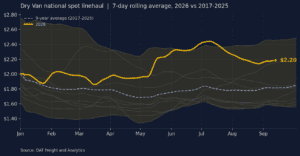
Dry van spot linehaul rates paid to carriers averaged $2.20 per mile last week, minus fuel, down 0.6%, or $0.01 per mile, from the prior week.
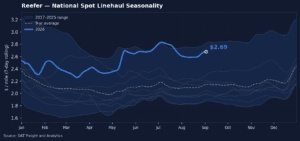
Reefer spot linehaul rates paid to carriers averaged $2.69 per mile this week, minus fuel, up 2.1%, or $0.06 per mile, from the prior week.

With peak produce season fading to the background, now’s the time to shore up your carrier sourcing and take a look at your pricing strategies.
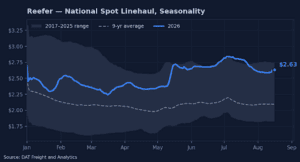
Reefer national spot linehaul rates paid to carriers averaged $2.63 per mile last week (minus fuel), down 0.2%, or $0.01 per mile, from the prior week.
Rates cooled after July Fourth, as they usually do. What’s different is how fast this market moves when conditions change.