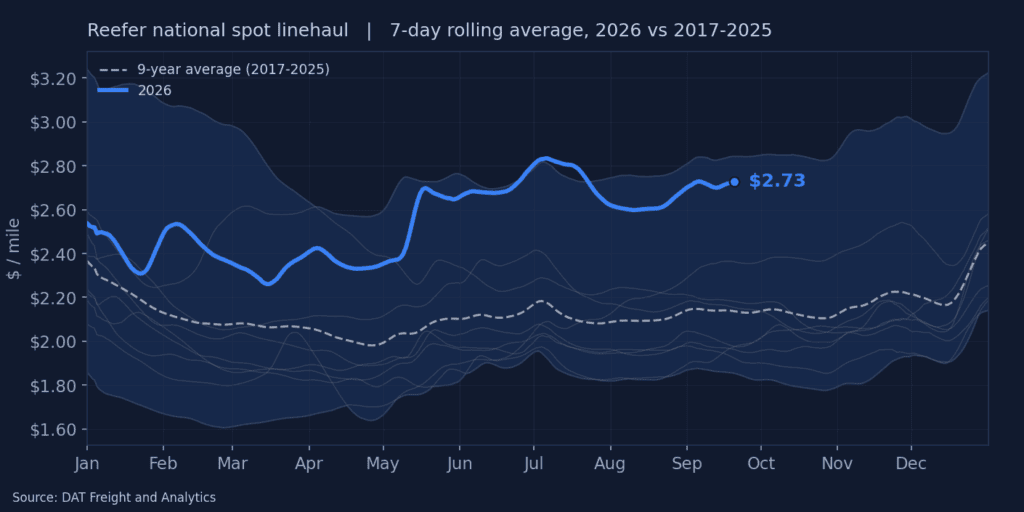
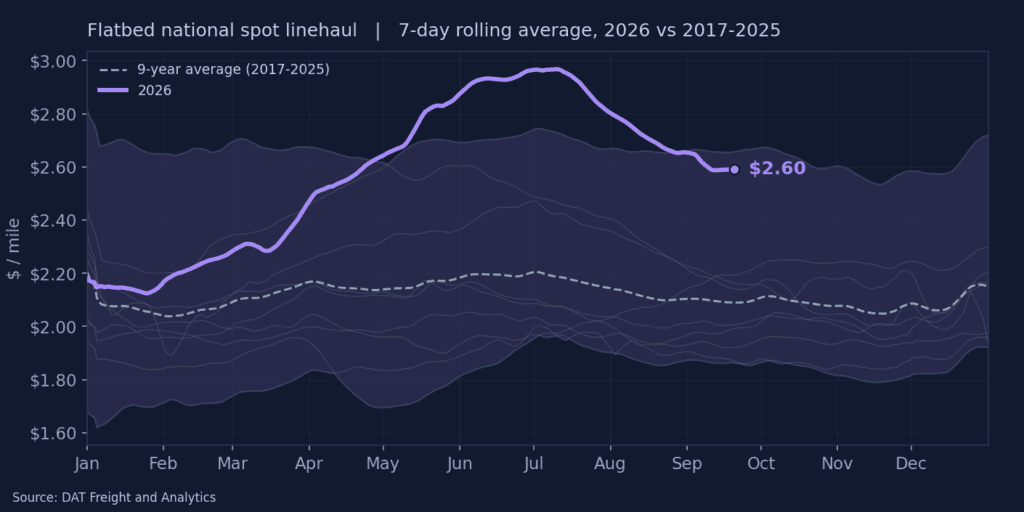
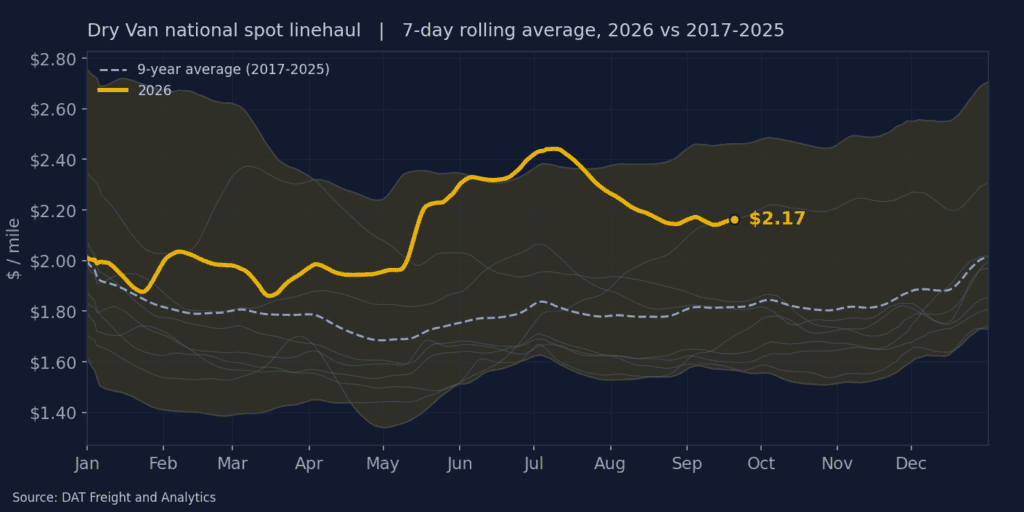
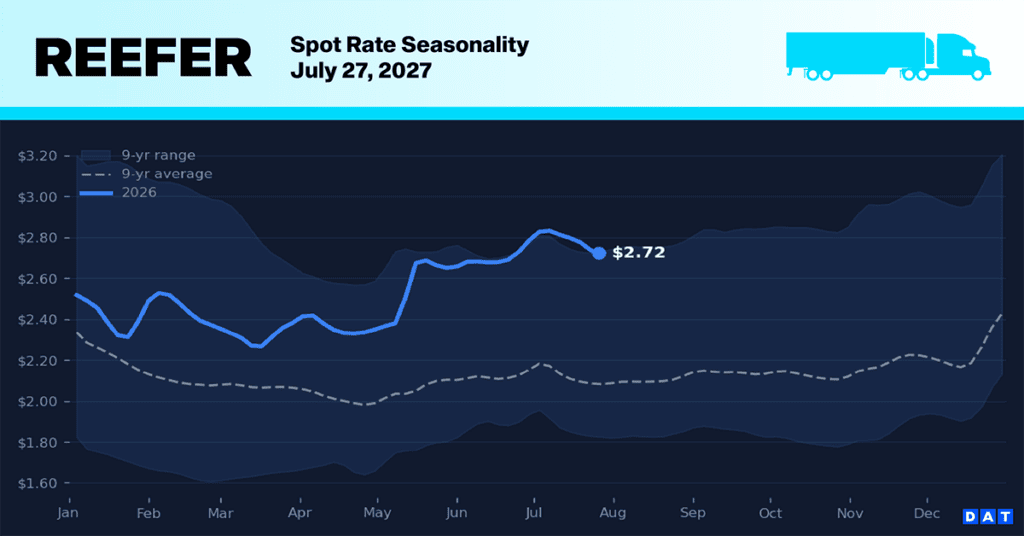
The ongoing re-pricing of the truckload market remains supply-led, a trend underscored this week by tightening rates for California citrus despite year-to-date volumes trailing last year by 8%. Capacity has noticeably constricted over the past seven days: while all South/Central citrus lanes were classified under a Slight Shortage last week, the entire eastern corridor — encompassing Baltimore, Boston, Miami, New York, and Philadelphia—has escalated to a full Shortage. Meanwhile, Western destinations and Dallas continue to experience a Slight Shortage. Week-over-week rate adjustments were minimal, with flat performance across four eastern lanes, though year-over-year premiums remain substantial, ranging from +21% to +103%.
California’s navel harvest wraps up around the Fourth of July, handing the summer citrus book to Valencias, lemons and grapefruit — a thinner supply window that offers a plausible read on why the eastern lanes have tightened. Elsewhere it’s a softening-but-elevated picture. Vidalia onions pulled back hard on the week (double-digit drops to several markets) as the storage crop moved past its peak, yet still print +26–42% over last year. South Texas crossings, flat as a board last week, gave back 8–9% to most markets while New York and Boston firmed. And the eastern watermelon program is migrating north: Georgia filed its Last Report of the season (tomatoes and melons, flat after last week’s collapse) while North Carolina and Delaware/Maryland/Eastern Shore Virginia both opened with First Reports for watermelons.
California Citrus — South & central district
Availability tightened: the eastern markets moved to Shortage this week. Rates are holding, not climbing, but they’re holding high. Seattle is the standout — sitting at roughly double last year’s number.
There’s a structural driver underneath the West Coast worth naming: Federal enforcement on non-domiciled CDLs — the FMCSA final rule effective March 16, 2026, since upheld through its first court challenge — together with roadside English-language-proficiency removals is thinning the driver pool fastest in the immigrant-heavy produce corridors, California among them. That’s why refrigerated rates can hold firm even as volumes run lighter. California’s program is in a fight over roughly $160 million in federal highway funds, with oral arguments on September 11 and a funding cutoff set for October 1.
Watermelon handoff — Georgia closes, the Carolinas and Delaware, Maryland, and Virginia Open
Georgia — last report of the season. The GA/FL complex (tomatoes and watermelons) posted flat across the board this week, stabilizing after last week’s steep collapse (down 19–29% a week ago). Note the season’s final Georgia book carried tomatoes alongside melons, where a year ago the late-July Georgia program was watermelons only — the YoY figures below reflect current-week rates against that prior-year book.
Vidalia onions — softening off peak
Sharp week-over-week pullback everywhere, led by Baltimore and New York (−13% each), but rates remain well above a year ago. Adequate capacity availability district-wide.
Mexico crossings through South Texas — giving back last week’s Hold
Flat a week ago, softer this week to most markets — but the Northeast bucked it, with Boston and New York firming. Surplus truck availability. Still +14–34% over last year where the lane ran in both books (Boston and New York weren’t quoted in 2025, so WoW only).
Pacific Northwest — Yakima valley steady
Apples, blueberries, cherries, pears and rhubarb. Quiet week-over-week (most lanes flat or ±2%) but a firm +8–39% over last year across the board. Adequate truck availability.
California coastal & desert vegetables — broadly Soft, still up big YoY
Mixed lettuce, brassicas, celery, strawberries and carrots off the coast and the desert. Rates drifted lower on the week across most lanes, but where a comparable lane ran a year ago, they’re +28–44% over 2025. All Adequate.
What this means for carriers, shippers, and brokers
Carriers: The money is in California citrus out of the South/Central district — those $10K+ eastbound lanes to Baltimore, Boston, New York and Philadelphia are now carrying truck Shortage designations, which means capacity is scarce and you have leverage on the rate. Don’t discount that tightness. On the flip side, South Texas and Vidalia are softening; if you’re running those, book sooner rather than later before rates settle further. The northern watermelon lanes (North Carolina, DelMarVa) are just opening — short hauls, modest money, but steady summer volume if you want backfill in the East.
Shippers: Citrus out of California will keep costing you, and it isn’t a rate spike you can wait out — it’s a thin-supply, tight-truck window that typically runs through summer on Valencias and lemons. Book citrus capacity early and expect to pay the premium. Where you have flexibility, the softening in South Texas produce and Vidalia onions is working in your favor this week; you may find room to negotiate on those.
Brokers: Watch the citrus availability line, not just the rate. Four eastern lanes printed flat while flipping from Slight Shortage to Shortage of trucks — that’s the market telling you trucks are getting harder to find even though the number didn’t move. Price the risk of that tightening in. The Georgia-to-Carolinas watermelon handoff is your other lane to manage: Georgia’s book is closed, and demand is shifting to North Carolina and DelMarVa origins — reposition your melon coverage north for the back half of summer.