Reefer spot rates
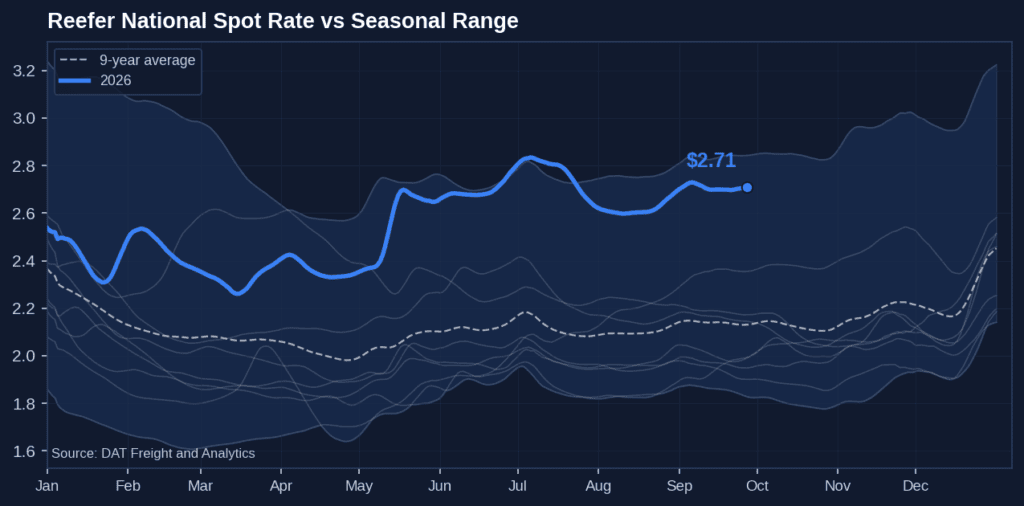
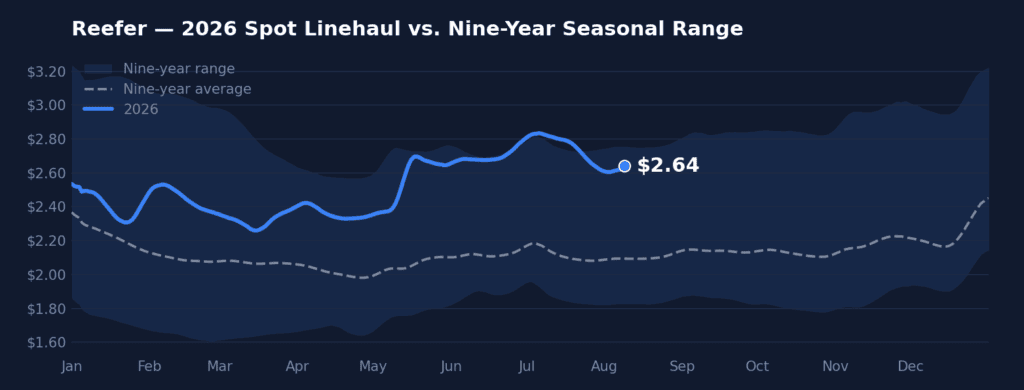
Reefer spot linehaul averaged $2.64 per mile this week, minus fuel, down 0.3%, or $0.01 per mile, from the prior week. Rates climbed 35%, or $0.68 per mile, year over year and held 26.2%, or $0.55 per mile, above the nine-year seasonal average of $2.09 per mile, near the top of the historical range.
All rates cited are linehaul only. They exclude fuel costs and surcharges unless otherwise noted.
Get the clearest, most accurate view of the truckload marketplace with data from DAT iQ.
Tune into DAT iQ Live, live on YouTube or LinkedIn, 10am ET every Tuesday.
Bellwether states
The 10 reefer bellwether states posted a moves-weighted outbound rate of $3.60 per mile this week, down 0.6%, or $0.02 per mile, week over week and up 40.7%, or $1.04 per mile, year over year. The roster carried 41.2% of all U.S. state-outbound reefer loads, at the upper end of its 38 to 40% baseline.
Regional rate trends
| Reefer — Top 10 Origins by Rate Per Mile · Week Ending August 7, 2026 | ||||
|---|---|---|---|---|
| Rank | Origin Region | Avg RPM | WoW % | YoY % |
| 1 | Ohio River | $3.20 | +1.0% | +40.3% |
| 2 | Lower Midwest | $3.20 | +0.8% | +41.0% |
| 3 | Great Lakes | $3.09 | +1.4% | +36.3% |
| 4 | California | $2.97 | -3.7% | +34.0% |
| 5 | Southeast | $2.65 | -4.4% | +38.6% |
| 6 | Upper Atlantic | $2.54 | +2.2% | +34.7% |
| 7 | Carolinas | $2.52 | -2.3% | +37.8% |
| 8 | South Central | $2.52 | -3.8% | +34.1% |
| 9 | Lower Mountain | $2.36 | -1.6% | +27.3% |
| 10 | Florida-So Georgia | $1.62 | -6.0% | +33.7% |
The top 10 origins carried 84.3% of all U.S. outbound loads moved in the week. Upper Atlantic led week over week at +2.2%, while most leading origins eased from the prior week as summer volumes softened.
Market conditions
Load posts were down 6.2% week over week and up 48.5% year over year, while truck posts were down 9.4% week over week and down 30.2% year over year. With capacity pulling back faster than freight, the load-to-truck ratio rose to 19.51, up from 18.86 a week earlier and 9.17 a year ago.
Short-term outlook
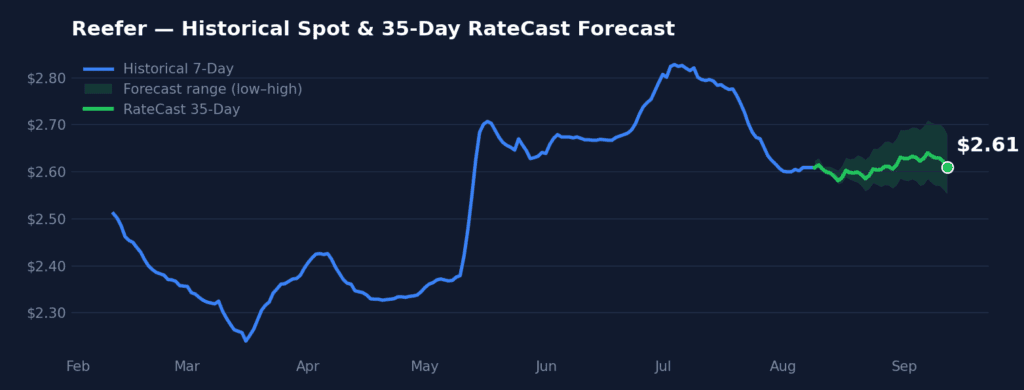
The 35-day DAT Rate Forecast puts reefer spot linehaul at $2.61 per mile in mid-September, within an uncertainty band of about plus or minus $0.06 per mile, or 2.4% of the forecast point. Across equipment, the reefer band ranks narrowest. That end-of-forecast rate stands about $0.57 per mile above the actual rate near the same date a year earlier, $2.04 per mile.
Freight demand outlook
The big picture
The reefer produce market took a broad step back week over week, but off a plateau that still sits far above 2025. Nearly every California vegetable district, all of South Texas, and most of the Vidalia onion book printed lower WoW numbers this week, yet those same lanes are running roughly 15% to 50% over last year, with the tightest citrus and Washington tree-fruit lanes stretching to +96%. The peak is easing, not collapsing, and last year’s floor is nowhere in sight as truckload volumes sit 8% lower year to date.
Last week (Aug 4) the story was a flat WoW book holding at elevated truckload rate levels; this week the plateau starts to erode, with California mixed-veg lanes off 4 to 11%, South Texas down 5 to 11% across the board, and Vidalia onions shedding double digits on most destinations. The one region refusing to give ground is South and Central California citrus, where Slight Shortage-to-Shortage truck conditions are pinning Northeast lanes above $10,000 even as everything around them softens. Washington tree fruit is the other holdout, flat WoW to every one of its ten cities but still up 15% to 32% on the year. Keep an eye on Brake Check Week coming up (Aug 23 to 29); it could again have an outsized impact on California eastbound lanes.
California citrus — the deck that won’t budge
South and Central California’s summer citrus (grapefruit, lemons, oranges) is the marquee freight of the week. The citrus book runs Slight Shortage of trucks to most markets, with Boston, Miami, and New York tagged full Shortage. Rates are essentially flat WoW — a few Northeast lanes eased 4 to 6% — but the year-ago gap is enormous, and part of that spread reflects the availability differential versus 2025, when the same district was Adequate across the board.
The Seattle lane is the standout, nearly double last year’s number. Last year Seattle was paying $2,600 to $3,100 per load.
California vegetables — broad WoW relief off a high base
The rest of California’s mixed-vegetable book (lettuces, broccoli, cauliflower, celery, cilantro, strawberries, and the leafy complex) softened across nearly every district this week, all under Adequate truck availability. The pullback is real WoW, but the year-over-year premiums where we have a clean lane match remain in the mid-20s to low-40s percent.
Santa Maria (Adequate): A new Santa Maria to New York lane appears this week (first report, no prior-week comparison), and USDA issued a correction to include the Salinas-Watsonville to Philadelphia lane. The rest of the district is mixed — Chicago and Seattle firmed sharply while the Northeast eased.
Mexico crossings through South Texas — easing across the board
South Texas (peppers, tomatoes, cucumbers, limes, the full Mexican-crossing mixed load) is Surplus on trucks and softened on every single lane WoW — the cleanest broad pullback in the report, off 5 to 11% as volumes sit 3% lower year to date, following last week’s 3% decrease. But even after the retreat, the matched lanes sit 9 to 31% above last August.
Washington tree fruit — flat and firm
Yakima Valley and Wenatchee (apples, blueberries, cherries, pears, rhubarb) held flat WoW to all ten destination cities under Adequate availability — a full-book flatline as the fresh apple deal builds. Every matched lane is up double digits on the year, led by the Northeast.
Vidalia onions — the storage deck pulls back
Georgia’s Vidalia dry-onion book (Adequate) came off a run of flat weeks with a sharp WoW correction — down 9 to 15% to most markets, with Miami the lone gainer. Even so, truckload rates are running above last year, with the long westbound haul to Los Angeles up nearly a third.
Eastern watermelon — the deal sits in DelMarVa and the Carolinas
With the Georgia and Florida watermelon season closed, the eastern melon book now runs out of DelMarVa and North Carolina. DelMarVa carries Slight Shortage conditions to most markets (Chicago Adequate) and is climbing into the Southeast — the Atlanta lane is up two weeks running (+9% last week, +13% this week), and it’s up +42% on the year. North Carolina (Adequate) sits flat this week after a steep drop the prior week.
What this means for carriers, shippers, and brokers
Carriers. The premium freight this week is West Coast and northbound. South and Central California citrus is running above $10,000 into the Northeast with Slight Shortage-to-Shortage truck conditions — that’s where the tightest capacity and best rates sit, and it’s holding while the mixed-veg decks around it soften. Watch for these lanes to stay tight through Brake Check Week. Washington tree fruit is flat but well above last year across all ten cities, a dependable book as the apple deal builds. In the East, DelMarVa watermelon into Atlanta and Boston is climbing week over week, worth positioning for. Treat the broad WoW softening in California vegetables and South Texas as the market coming off a peak, not falling apart: those lanes are still paying 15 to 50% over last August.
Shippers. This is a better week to cover most California mixed-vegetable and South Texas freight; the WoW relief is real and broad. But temper expectations: you are still paying a large premium against last year, and 2025 pricing is not coming back near term. Citrus and Washington tree fruit will stay firm as long as availability is tight, so lock those lanes rather than chasing a dip that isn’t likely to come. West Coast capacity is much thinner than it looks.
Brokers. The widest range-to-mostly spreads sit on the tight citrus lanes — that’s where the margin is, but cover early on the Boston, Miami, and New York Shortage lanes before capacity gets away from you. On the softening California veg and South Texas book you have room to work rates down with customers this week. When shippers push back on pricing, the year-over-year gap is your framing: nearly every lane in this report is a double-digit premium over last August, and the tight decks are far more than that. Lock in capacity ahead of Brake Check Week.
Weekly reports