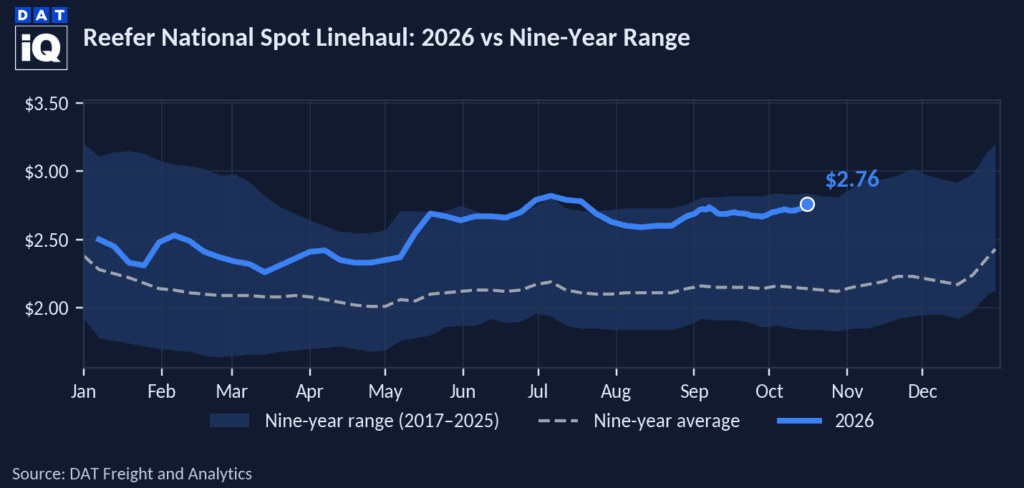
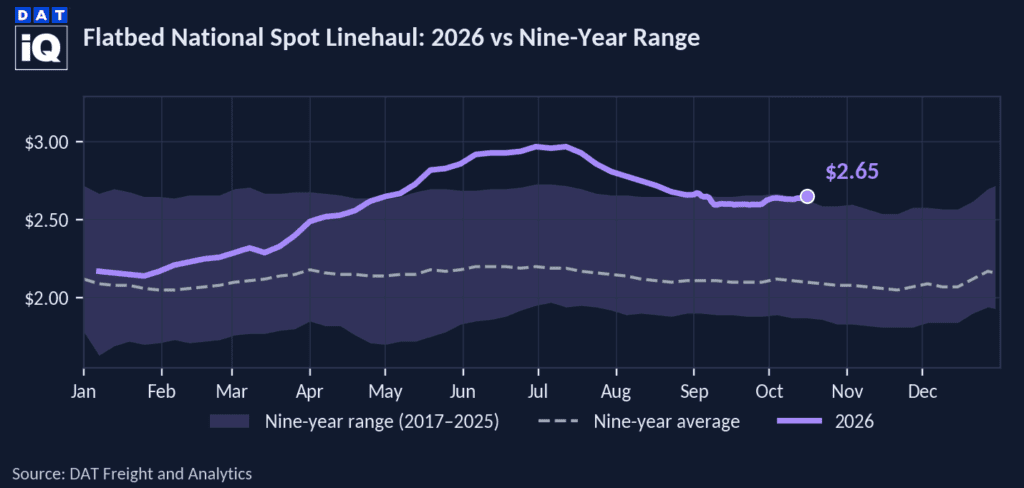
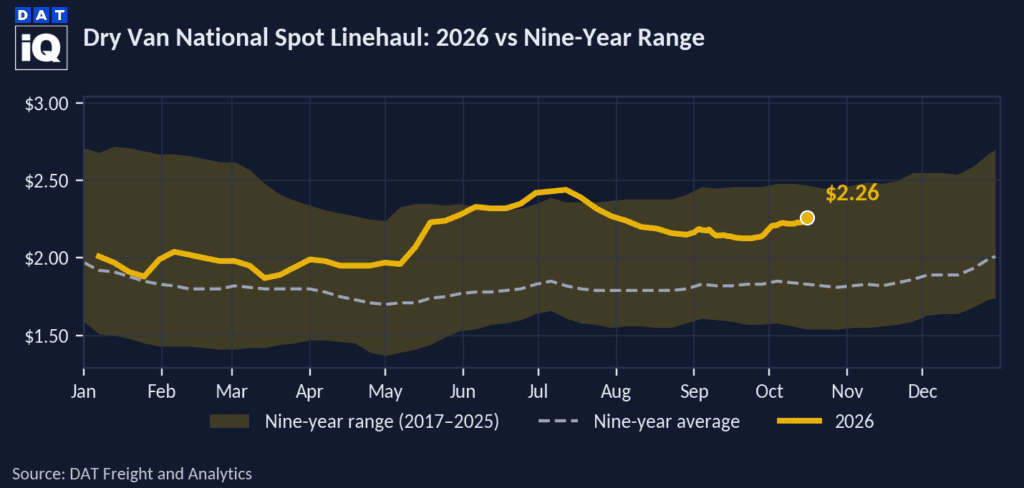
Reefer spot linehaul rates paid to carriers averaged $2.71 per mile last week, minus fuel, down 0.7%, or $0.02 per mile, from the week before. Rates ran 36.1%, or $0.72 per mile, higher year over year and held 27.1%, or $0.58 per mile, above the nine-year seasonal average of $2.13 per mile, near the top of the historical range.
All rates cited are linehaul only. They exclude fuel costs and surcharges unless otherwise noted.

Get the clearest, most accurate view of the truckload marketplace with data from DAT iQ.
Tune in to DAT Market Update, Mondays at 11am Eastern.
Bellwether states
Across the reefer bellwether states, the moves-weighted outbound rate came in at $3.59 per mile last week. It held essentially flat week over week, moving less than a cent per mile, and was up 38.0%, or $0.99 per mile, from a year earlier. Those states carried 41.1% of the country’s outbound reefer loads last week, up from 40.9% the week before last and 39.4% a year ago, in line with the 38% to 42% share the group usually holds.
Regional rate trends
| Reefer — Top 10 Origins by Rate Per Mile · Week Ending September 25, 2026 | ||||
|---|---|---|---|---|
| Rank | Origin Region | Avg RPM | WoW % | YoY % |
| 1 | Upper Midwest | $3.60 | +2.0% | +48.3% |
| 2 | Great Lakes | $3.51 | +0.1% | +45.5% |
| 3 | Lower Midwest | $3.28 | +1.0% | +39.4% |
| 4 | Ohio River | $3.28 | -0.1% | +43.0% |
| 5 | Pacific Northwest | $3.17 | +4.2% | +50.3% |
| 6 | California | $2.95 | -3.3% | +33.9% |
| 7 | Upper Atlantic | $2.85 | -0.7% | +43.8% |
| 8 | Southeast | $2.41 | -2.4% | +30.9% |
| 9 | Lower Mountain | $2.39 | -0.8% | +26.7% |
| 10 | South Central | $2.24 | -1.0% | +22.1% |
The top 10 outbound reefer markets accounted for 84.1% of the loads moved last week. Pacific Northwest held up best week over week, up 4.2%, or $0.13 per mile, while Upper Midwest posted the next-strongest weekly gain at 2.0%. Every market in the top 10 remained well above its year-ago level, with gains ranging from roughly 22% to 50%.
Market conditions
Reefer load posts pulled back 8.1% from the week before last, though they still sat 32.4% above a year ago. Equipment posts declined 8.4% on the week and trailed last year by 20.1%, so both sides of the market eased in step. That balance left the load-to-truck ratio close to steady at 18.26, against 18.20 the week before, as the early produce push paused.
Short-term outlook

The 35-day DAT Rate Forecast places reefer spot near $2.69 per mile by late October, inside a confidence band of about plus or minus $0.06 per mile, or 2.4% of the forecast, the narrowest of the three equipment types. That endpoint sits about $0.63 per mile above the actual rate around this time last year, when reefer ran $2.07 per mile, so the year-over-year premium holds even as week-to-week movement settles.
Freight demand outlook
The big picture
California is running the table last week. After a dead-flat week before last, where nearly every California vegetable lane printed flat, the salad districts snapped higher across the board — with Chicago and Miami leading the move. Chicago increased 11% to 19% out of four separate California origins, and Miami jumped 14% to 17% out of the Imperial/Coachella and Santa Maria baskets, paying around $3,000 more per load than a year ago. It’s a clean reversal off the plateau from the week before last.
The bigger structural story sits underneath the vegetables: California citrus and Washington tree fruit are both trading at extraordinary premiums to a year ago. South & Central California citrus held every lane flat last week — but it held onto the double-digit surge from the week before last, leaving the district up roughly 40% to 72% year over year into all ten cities. Yakima apples and pears carried no week-over-week print last week, yet the year-over-year gap is even wider — 50% to 72% — with Miami topping the entire report at $13,500–$14,800, paying carriers almost $4,500 more than a year ago.
Out East, watermelon is winding down but not quietly: Delmarva pushed a 25% week-over-week move into New York and sits 38% to 90% higher year over year across its lanes. South Texas cooled after the climb from the week before last, giving back ground on the Boston, Chicago, Dallas, and New York runs. And Vidalia is now off the board — the report from the week before last was its last of the season.
South & Central California: citrus holds its spike
The headline district. South & Central California now publishes two baskets: a vegetable/citrus mixed basket and a dedicated grapefruit, lemons, and oranges citrus basket. The citrus lanes are where the money is.
Citrus printed flat on all nine lanes last week — but that comes on the heels of a 10% to 23% surge the week before last, so the district has locked in its new, elevated floor rather than giving any of it back. Against a year ago, the premiums are stark.
Yakima Valley & Wenatchee: tree fruit at the top of the board
Apple-and-pear harvest freight is the priciest produce on the sheet. The basket narrowed to apples and pears last week (blueberries and peaches dropped off the list the week before last). USDA published no week-over-week change on any Yakima lane, so these show year-over-year alone — and the year-over-year is enormous. DAT reefer spot rates for outbound Yakima loads for all commodity types and temperature settings are 60% higher year over year, with Miami the single highest-priced lane in the entire report. Seven of ten Yakima lanes clear $10K. This is peak fall apple/pear shipping out of Washington, and the rate structure reflects it.
The California salad complex: broad step-up after a flat week
Every coastal and desert vegetable district moved higher last week after a fully flat week before that. The common thread: Chicago and Miami led, while a few western/southern lanes softened.
Delaware-Maryland-Virginia: watermelon’s late-season kick
Delmarva watermelon is deep into the tail of its season, and rates are running well ahead of last year. The New York lane jumped 25% week over week, and every lane sits sharply higher year over year — Chicago nearly doubled against a year ago.
South Texas crossings: pullback after the week-before-last climb
South Texas gave back ground last week after gaining across the board the week before last. The Boston lane dropped 16% week over week and Dallas fell 7%, though year over year the district remains well elevated where a prior-year lane exists (mixed peppers, tomatoes, cucumbers, limes, citrus, watermelons).
North Carolina: watermelon grinding higher
North Carolina watermelon posted small gains on every lane, with the Atlanta run leading (week over week only — no prior-year North Carolina counterpart).
New last week
- Vidalia, Georgia is done. The onion report from the week before last was Vidalia’s last of the season; the district was off the board last week.
- The Yakima basket narrowed to apples and pears (blueberries and peaches rolled off).
- California vegetables reversed out of a fully flat week before last into a broad step-up.
What this means for carriers, shippers, and brokers
Carriers. The premium freight is stacked in two places — Washington tree fruit and California citrus — and both are running $10K+ into the eastern and southern cities. Yakima to Miami at $13,500–$14,800 and the South & Central citrus lanes into the Northeast are the top-dollar runs on the board right now. If you can position for the Pacific Northwest apple/pear pull or the SoCal citrus lanes, that’s where the revenue per mile is. On the California salad side, the Chicago and Miami lanes moved hardest last week — worth chasing while the step-up holds. Watch the softer western/southern lanes (Imperial to Seattle -15%, South Texas to Boston -16%) before committing.
Shippers. Citrus and tree fruit costs are not easing — South & Central citrus held its spike flat rather than retreating, and Yakima is up 50% to 72% against last year with no relief in the current print. Budget the elevated numbers as the new baseline into the holidays, not a temporary peak. On vegetables, last week’s California increases were broad but modest in dollar terms; the Chicago and Miami lanes are the ones re-pricing fastest. Watermelon out of Delmarva and North Carolina is climbing week over week as the season tightens toward its close — lock coverage early if you still need melons.
Brokers. The clearest arbitrage last week was the California vegetable reversal — four origins pushed double-digit gains into Chicago and Miami off a flat base, so re-check any quotes built on the flat numbers from the week before last before they go stale. Citrus was the opposite trade: flat last week but sitting on a big two-week gain, so there’s no urgency to chase it higher — hold your margins. South Texas was the one district drifting down; if you’re buying, the Boston, Dallas, and New York lanes were cheaper than the week before. And with Vidalia closed, redirect any onion demand accordingly.