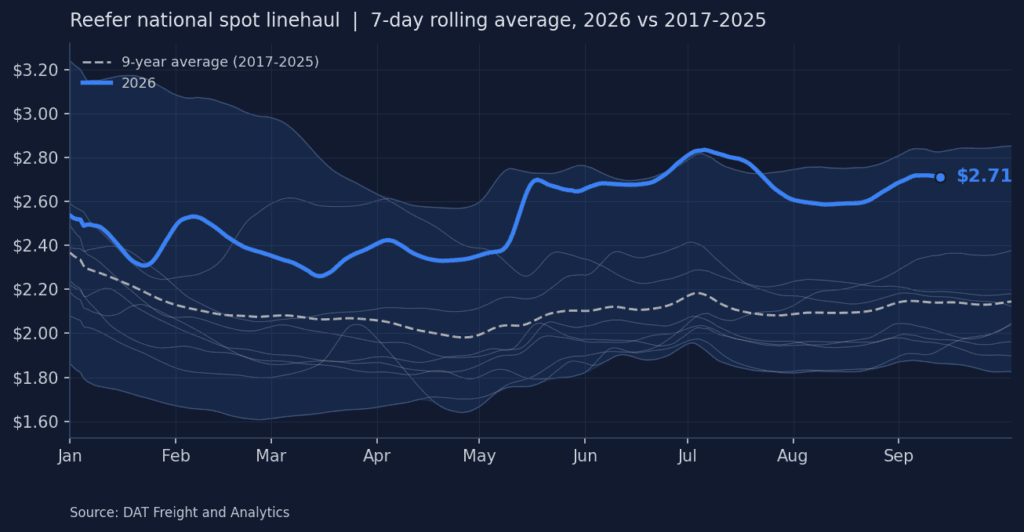
Reefer spot linehaul averaged $2.73 per mile last week, minus fuel, up 0.7%, or $0.02 per mile, from the week before. Rates climbed 37.9%, or $0.75 per mile, year over year and held 27.9%, or $0.60 per mile, above the nine-year seasonal average of $2.14 per mile, near the top of the historical range.
All rates cited are linehaul only. They exclude fuel costs and surcharges unless otherwise noted.
Get the clearest, most accurate view of the truckload marketplace with data from DAT iQ.
Tune into DAT iQ Live, live on YouTube or LinkedIn, 10am ET every Tuesday.
Market conditions

Reefer load posts climbed 8.3% from the week before and 48.5% from a year ago, though they remained about 7.2% below the pre-Labor Day August pace, leaving the segment just short of a full rebound. Equipment posts grew 3.3% on the week and were essentially back to their August level, up 0.9%, even as they trailed last year by 23.7%. The load-to-truck ratio tightened to 19.06 as produce demand firmed.
Short-term outlook

The 35-day DAT Rate Forecast projects reefer spot around $2.69 a mile over the next 35 days, within the narrowest band of the three equipment types at roughly plus or minus $0.07 a mile, or 2.4% of the forecast. The forecast endpoint runs about $0.61 a mile above where reefer stood near this date a year ago, at $2.08, and the tight band reflects the steadier path produce-season demand tends to set into the fall.
The big picture
The week before, the story was South Texas firming while California cooled. This week California split in two: the coast vegetable districts stayed flat, while South and Central California citrus broke sharply higher, posting double-digit weekly gains to all ten of its destinations after sitting flat the week before that. Those lanes now run 35% to 72% above a year ago, the widest citrus premium DAT iQ has tracked this season. The Pacific Northwest is the other headline. Yakima’s apple-pear harvest lanes reset this week and now run 48% to 84% above a year ago, with Boston, Miami, and New York all clearing $13,000 or more at the top of the range; outbound Yakima Valley spot rates hit $2.90 a mile excluding fuel, a four-year high and already 16% above the typical late-November level of the past four years. South Texas crossings kept firming for a second straight week, and Vidalia onions filed their last report of the season on a strong year-over-year note. Everything else, including the coast vegetable complex and watermelons out of the mid-Atlantic and Carolinas, held flat week over week but remained well above 2025.
South and Central California: citrus breaks out
The citrus basket out of South and Central California — grapefruit, lemons, and oranges — had been flat for weeks. This week it moved in one direction: every destination posted a solid weekly gain, and every lane runs comfortably above last year. Chicago led the week at +23%, and the eastern long-hauls, Boston and Miami, carried both the widest dollar ranges and the fattest year-over-year premiums. Nine of nine destinations moving together points to a deal that firmed everywhere at once, not on a single lane. The district’s vegetable basket — anise, artichokes, avocados, and lettuces among them — told the opposite story: flat, with no clean 2025 comparison available.
Yakima Valley, Washington: harvest lanes reset and run hot
Yakima’s basket shifted this week to apples, blueberries, peaches, and pears, so USDA published no week-over-week read against the changed mix. The year-over-year comparison is the story: every lane ran 48% to 84% higher, with four eastern destinations posting $12,000 to $14,800 at the top of range, the priciest lanes on the board this week. In RateView, spot rates from the Pacific Northwest to the East Coast are holding 47% above last year.
Mexico crossings through South Texas: a second straight week firmer
South Texas kept climbing. After firming the week before, nearly every destination posted another weekly gain, and lanes with a 2025 comparison ran 27% to 75% higher year over year. The standout was the westbound pull to Los Angeles, up 14% on the week and 75% on the year. Boston, at $8,000 to $8,400, was the priciest South Texas lane.
Vidalia district, Georgia: last report of the season
Vidalia onions filed their final report of the season this week. USDA published no week-over-week figures against the closing quote, but the year-over-year read was strong across the board, with every lane up 18% to 40% versus the same week in 2025. That closes the Georgia dry-onion lane for the year; expect these destinations to source from stored or other-origin supply going forward.
California coast vegetable complex: quiet week, rich year
The California coast vegetable districts — Imperial-Coachella, Kern, Oxnard, Salinas-Watsonville, and Santa Maria — held flat almost everywhere week over week, but where a 2025 lane exists for comparison, they are running 23% to 43% above last year. Imperial-Coachella, western Arizona, and Calexico-San Luis, which ship mixed vegetables and berries, were flat on every lane, with no 2025 district available for comparison.
Mid-Atlantic and North Carolina: watermelons softening but still up
Mid-Atlantic watermelon lanes out of Delaware, Maryland, and the eastern shore of Virginia drifted lower week over week on most destinations, though every one still sits above its 2025 mark. North Carolina watermelons have no 2025 counterpart in the year-ago report, so those figures reflect the weekly move alone; the week was mixed, with Chicago the notable soft spot.
What this means for carriers, shippers, and brokers
Carriers. The money this week is in two places: California citrus and Washington apples and pears. South and Central California citrus jumped double digits to every destination and pays $9,500 to $11,900 into the eastern metros, while Yakima tops $13,000 to $14,800 into Boston, Miami, and New York. South Texas is the third leg, with a second straight week of gains and the Los Angeles lane up 14% on the week. The coast vegetable deal is flat, so there is little upside sitting on those lanes right now.
Shippers. California citrus costs materially more than the week before and far more than a year ago, so budget for it and book early: a clean nine-of-nine move suggests the firming is broad, not a one-lane blip. Coast vegetable freight, by contrast, is stable and predictable, with no reason to chase trucks there. Shippers moving Georgia onions should line up stored or alternate-origin supply now that Vidalia has closed for the season.
Brokers. The spread opportunities are in the movers. Citrus and Pacific Northwest tree fruit are repricing upward fast, so lock rates ahead of tenders rather than chase the spot climb. Watch the divergence inside South and Central California, where citrus is rising while the vegetable basket sits flat, and price the two baskets separately rather than treat the district as one number. South Texas continues to firm, so contracted lanes booked at last month’s levels are now running well under current spot.