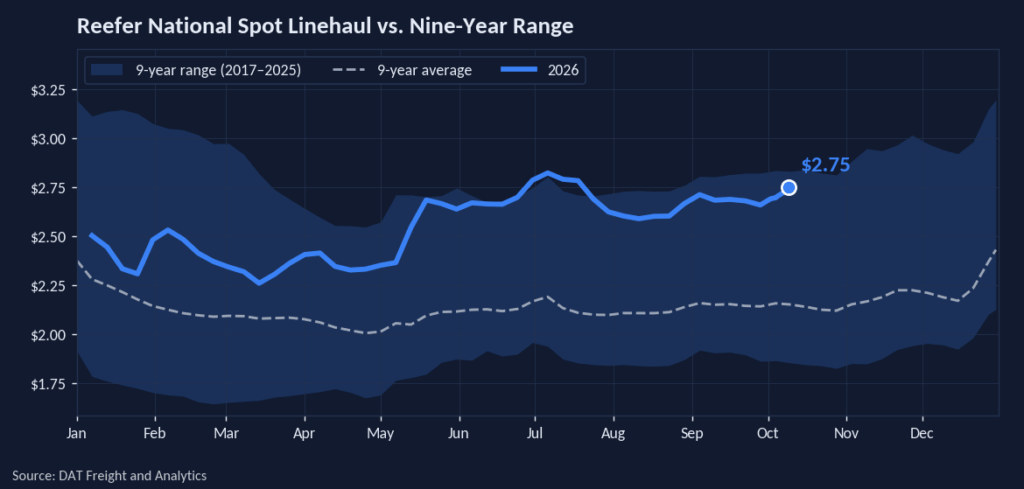
Reefer spot linehaul averaged $2.74 per mile this week, minus fuel, up 1.9%, or $0.05 per mile, from the prior week. Rates climbed 34.4%, or $0.70 per mile, year over year and held 27.2%, or $0.58 per mile, above the nine-year seasonal average of $2.15 per mile, near the top of the historical range.
All rates cited are linehaul only. They exclude fuel costs and surcharges unless otherwise noted.
Get the clearest, most accurate view of the truckload marketplace with data from DAT iQ.
Tune into DAT iQ Live, live on YouTube or LinkedIn, 10am ET every Tuesday.
Bellwether states
The 10 reefer bellwether states posted a moves-weighted outbound rate of $3.63 per mile this week, up 1.3%, or $0.05 per mile, week over week and up 35.8%, or $0.96 per mile, year over year. The roster carried 40.2% of all U.S. state-outbound reefer loads, at the upper end of its 38 to 42% baseline.
Regional rate trends
| Reefer — Top 10 Origins by Rate Per Mile · Week Ending September 4, 2026 | ||||
|---|---|---|---|---|
| Rank | Origin Region | Avg RPM | WoW % | YoY % |
| 1 | Great Lakes | $3.53 | +3.1% | +44.1% |
| 2 | Upper Midwest | $3.50 | +4.1% | +46.5% |
| 3 | Ohio River | $3.38 | +2.5% | +42.4% |
| 4 | Lower Midwest | $3.34 | +4.2% | +40.5% |
| 5 | California | $3.09 | +2.8% | +34.1% |
| 6 | Upper Atlantic | $2.95 | +2.4% | +44.4% |
| 7 | Pacific Northwest | $2.77 | +5.8% | +25.7% |
| 8 | Southeast | $2.50 | +1.7% | +32.0% |
| 9 | South Central | $2.34 | +0.9% | +25.1% |
| 10 | Lower Mountain | $2.33 | +1.9% | +19.9% |
The top 10 origins carried 84.3% of all U.S. outbound loads moved in the week. Pacific Northwest led week over week at +5.8%, with the Midwest corridors staying firm at the top of the table.
Market conditions

Reefer capacity came back the fastest of the three equipment types. Truck posts climbed 5.3% week over week, though they remain 18.7% below last year, while load posts eased 0.9% on the week and held 70.8% above a year ago. That pushed the load-to-truck ratio down to 21.49 from 22.84 a week earlier, more than double the 10.23 of a year ago.
Short-term outlook

The 35-day DAT Rate Forecast puts reefer spot linehaul at $2.68 per mile in mid-October, within an uncertainty band of about plus or minus $0.06 per mile (2.4% of the forecast point). Across equipment, the reefer band ranks narrowest. That end-of-forecast rate stands about $0.60 per mile above the actual rate near the same date a year earlier ($2.07 per mile).
Freight demand outlook
The big picture
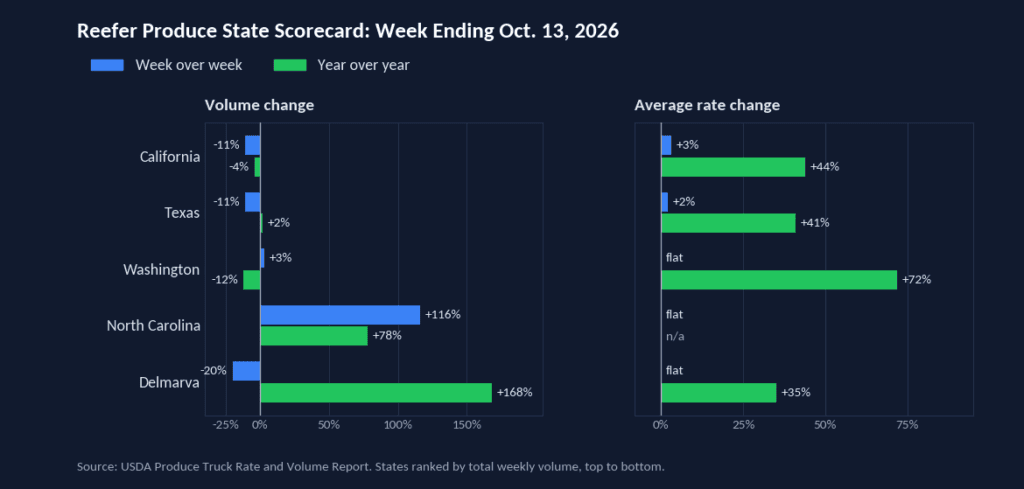
Washington tree fruit is the story this week. Yakima Valley delivered the only real week-over-week spike on the board — Yakima to Miami jumped 26% to a $12,500 to $13,500 load — while carrying the widest year-over-year premiums anywhere, from 29% into Dallas to 118% into Los Angeles. Outbound Yakima spot rates are at a four-year high, up 49% since the season low in early May and 34% above this time last year, as new-crop apples, pears and peaches command the richest per-load rates on the board.
Everywhere else, the shape is the same: rates well above a year ago, but week-to-week momentum flat to softening. California’s citrus and coastal-vegetable lanes still carry double-digit-plus year-over-year premiums, with South and Central California citrus running 23% to 72% over last year, though most lanes drifted negative or flat on the week as the late-summer market cooled off its peak. Eastern watermelons out of Delmarva and North Carolina eased further as those deals move toward their tail, Vidalia dry onions held flat across all nine destination cities, and South Texas crossings were flat on the week while holding solid year-over-year gains. The takeaway: a market broadly and substantially higher than a year ago, with the week-over-week energy concentrated almost entirely in the Pacific Northwest.
Washington tree fruit
Miami leads with a 26% weekly jump on top of a 67% year-over-year premium, one of the richest single lanes in the country at $12,200 per load including fuel, up 48% year over year. Most other destinations show no weekly move after the fruit basket shifted, but every lane sits 29% to 118% above last September.
California citrus
Grapefruit, lemon and orange lanes out of the South & Central district run 23% to 72% above last September, led by the longest southeastern and western hauls, though the district has cooled week over week, with most lanes flat to modestly negative.
California coastal and desert vegetables
Rates run 26% to 43% above last year where a prior-year lane exists, but the week itself was flat to negative across most of the coast, with the Chicago and Seattle lanes taking the sharpest weekly hits.
Eastern watermelon
Delmarva and North Carolina both eased a few points on the week as the deal moves past its peak. Delmarva still carries a heavy year-over-year premium, up 66% into Chicago, even as weekly rates slip.
Vidalia onions
Rates out of Vidalia, Georgia were unchanged week over week across all nine destinations, but the district runs meaningfully higher against last September, from 18% into Atlanta to 40% into Dallas.
Mexico crossings through South Texas
The mixed produce basket — peppers, tomatoes, limes, cucumbers, melons and more — was flat week over week on every lane, but sits comfortably above last year where a comparison exists, up to 30% into Atlanta.
What this means for carriers, shippers, and brokers
Carriers. The money this week is in the Pacific Northwest. Yakima tree fruit is pricing at the top of the market into nearly every destination — Miami above $13,000, eastern metros in the $9,000 to $11,000 band — with every one of those lanes running 29% or more above a year ago. California coastal produce still pays well on the long eastern hauls, but the weekly trend has turned soft, so don’t count on further upside near term. Treat the short eastern watermelon lanes out of Delmarva and North Carolina as fill freight, not anchor loads.
Shippers. If you’re moving Washington tree fruit, budget for elevated rates and book early rather than chasing a rising lane. On the California side, the flat-to-softening week is an opening — rates have stopped climbing, so there is less urgency to overpay. Vidalia onion shippers have a stable, predictable market to plan around.
Brokers. The spread to watch is Washington versus everywhere else — Yakima is the one origin with real weekly momentum, so margin discipline matters most there. Where a lane shows a big year-over-year number but a flat or negative week, such as Vidalia, South Texas and the California citrus book, price to the current week, not the year-ago anchor. The eastern melon deals are thinning, with fewer loads and softer rates as those regions wind down.