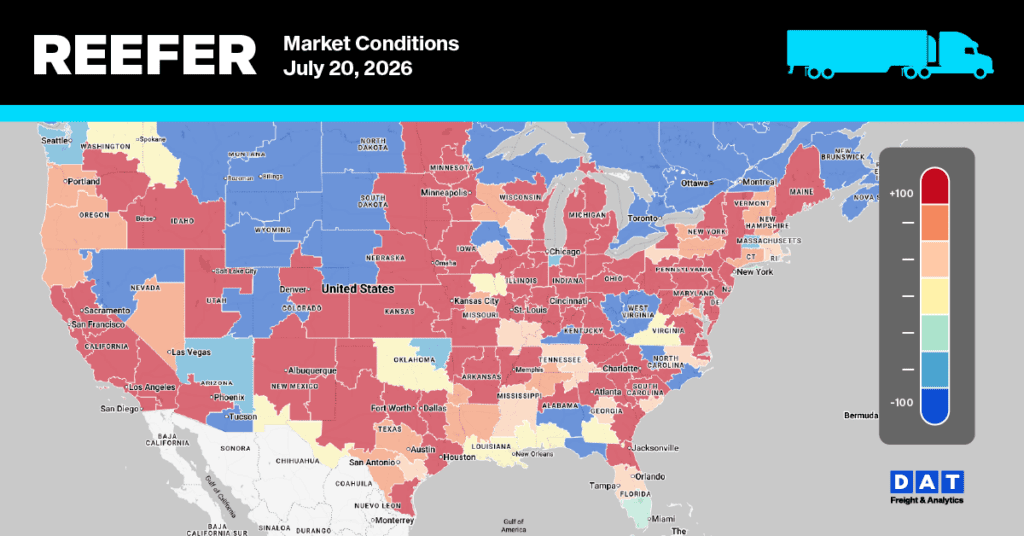
Last week’s post-holiday tightness didn’t just fade — it reversed. Across nearly every district, USDA flipped truck availability a full notch looser: California’s coastal and desert districts moved Slight Shortage → Adequate, Georgia/Florida’s tomato-watermelon complex went Shortage → Adequate/Slight Shortage, and South Texas jumped Slight Shortage → Surplus. With capacity easing everywhere at once, rates followed it down — the majority of lanes printed negative, and the sharpest drops landed on the Georgia/Florida produce complex (down -19% to -29% into the Northeast).
This is the clean unwind of the late-June/early-July firming arc. Two weeks ago Santa Maria was spiking (Boston +16%, Philadelphia +15%); this week it’s giving it back (Boston -10%, Philadelphia -7%). The narrative that’s been building — post-July 4 demand fade — now shows up unambiguously in the availability designations, not just the rate deltas. Only two spots held firm: South Texas rates sat dead flat even as the region loosened to Surplus (Mexican crossing volume absorbing the slack), and the Washington apple complex barely moved.
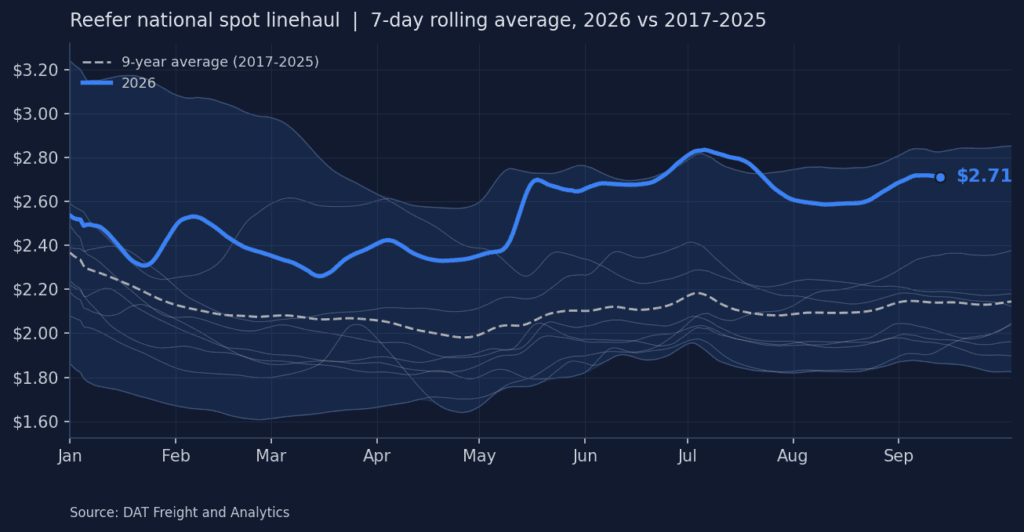
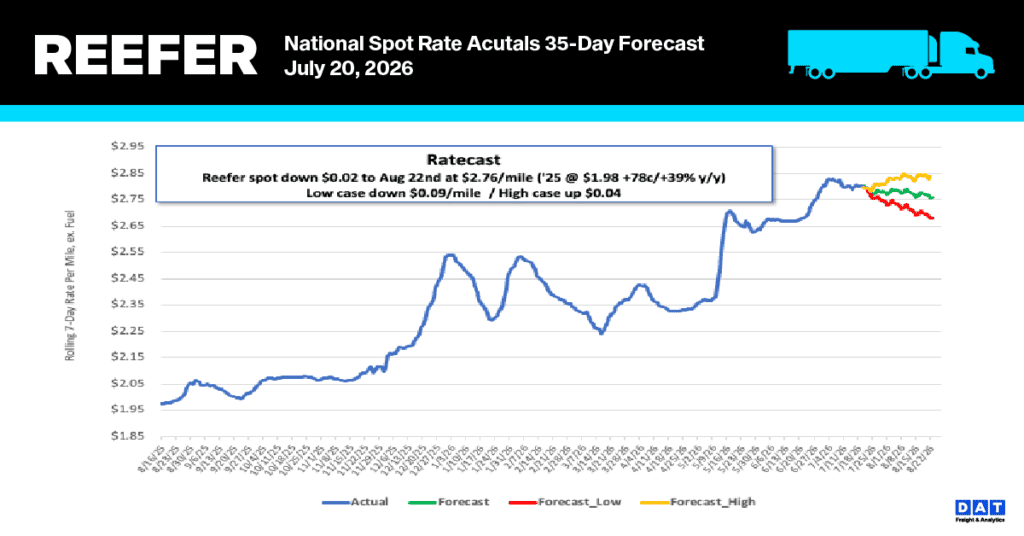
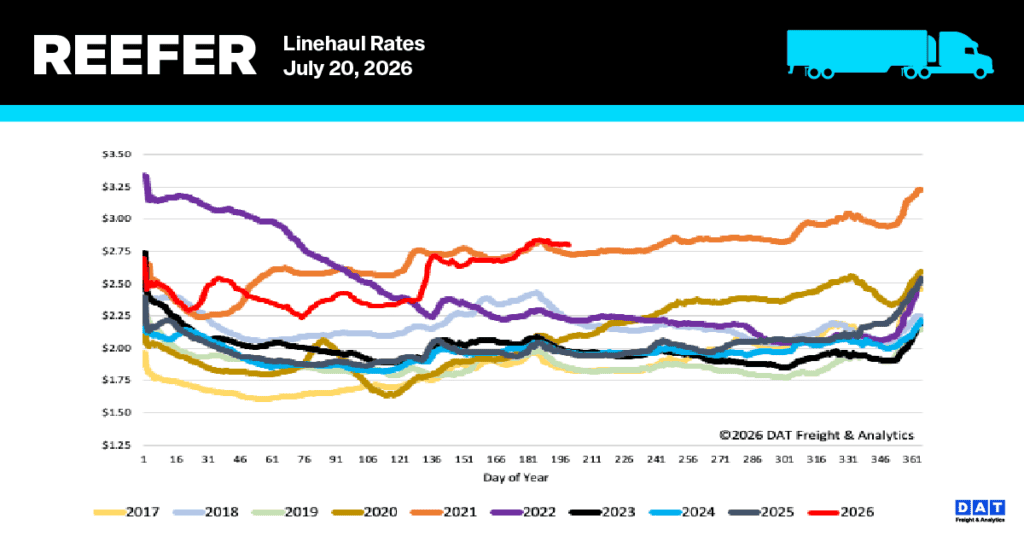
Against last year, though, the story flips. Even after this week’s softening, 2026 spot rates are running well above July 2025 on nearly every lane we can match across the two reports — California coastal and citrus, Vidalia onions, the Georgia/Florida complex, South Texas crossings, and Washington tree fruit are all up, most in the +30% to +70% range and citrus higher still. The market is cooling week-to-week off a structurally higher floor.
Season note: Nogales (Arizona) mangoes posted their Last Report on July 14 and have now dropped off the sheet entirely — Mexican mango crossings through Nogales are closed for the season.
Georgia & Florida — the watermelon/tomato complex (biggest mover)
The Georgia district (which includes West and North Florida) took the hardest hit of the week as its tomato and watermelon lanes collapsed. These are the steepest single-week declines on the board — consistent with a broad seasonal wind-down rather than one anomalous lane, a -29% drop for loads to Philadelphia is the largest lane to drop this week, but has been dropping for two weeks now, down almost $1,700 per load in DAT RateView ($4,700 to $3,000 this week).
California — coastal & desert vegetables (broad easing)
The entire California vegetable footprint stepped down from Slight Shortage to Adequate this week, and rates softened accordingly — heaviest into the Northeast, where last week’s spikes had been concentrated. Strawberries remain in the Oxnard, Salinas, and Santa Maria baskets. A handful of Chicago lanes bucked the trend and firmed, the one consistent pocket of strength inland.
California — south & central citrus (the one district still tight)
Citrus (grapefruit, lemons, oranges) is the lone California basket that held its Slight Shortage designation. This district quoted all nine destinations in both years, so it carries the fullest YoY coverage on the report. Rates eased WoW but remain dramatically elevated against 2025.
Vidalia (Georgia) — dry onions
Onions eased modestly WoW but remain a firm, Adequate market with wide range spreads on the long hauls (LA range $5,000–$7,200).
South Texas (Mexico crossings) — loosened to surplus, rates flat
South Texas is doing exactly what the multi-week arc predicted: absorbing overflow. Availability loosened a full notch to Surplus, yet every lane held dead flat WoW — capacity is ample but the crossing volume (peppers, limes, tomatoes, watermelons, tropicals) is holding rates steady rather than letting them slide.
Yakima Valley & Wenatchee (Washington) — tree fruit
The apple/cherry/pear/blueberry complex barely budged WoW (Adequate), with a soft patch on the LA lane.
What This Means for Carriers, Shippers & Brokers
Carriers: The easy money of early July is gone — availability loosened across the board and Northeast lanes are pulling back hard, so don’t chase last week’s Georgia/Florida or CA-coastal numbers. The two places to keep trucks pointed: South & Central CA citrus, which held Slight Shortage and still pays $10K+ into the Northeast, and South Texas, where Surplus availability didn’t drag rates down at all — flat crossing volume is holding the floor. Avoid deadheading into the Georgia/Florida watermelon complex; those rates are falling fast and the season is winding down.
Shippers: This is your re-entry window. With CA vegetable districts back to Adequate and Georgia/Florida easing from Shortage, you have leverage on Northeast lanes you didn’t have two weeks ago — Boston and NY out of California dropped double digits. Book now while the softening holds. The exception is citrus: it’s still tight and elevated, so don’t expect concessions on grapefruit/lemon/orange lanes out of South/Central California.
Brokers: The WoW cooldown is real and broad, but frame it against the year-ago floor before you quote — on the lanes that match both years, 2026 is running mostly +30% to +70% above July 2025 (citrus into Seattle is up +90%), so “cheap this week” is still expensive versus last year. Watch South Texas as the tell: it loosened to Surplus but rates held flat, which usually signals crossing volume is backfilling the capacity that left the tightening CA/Georgia markets. If that flat line breaks either direction next week, it’s your earliest read on where the back half of July heads.