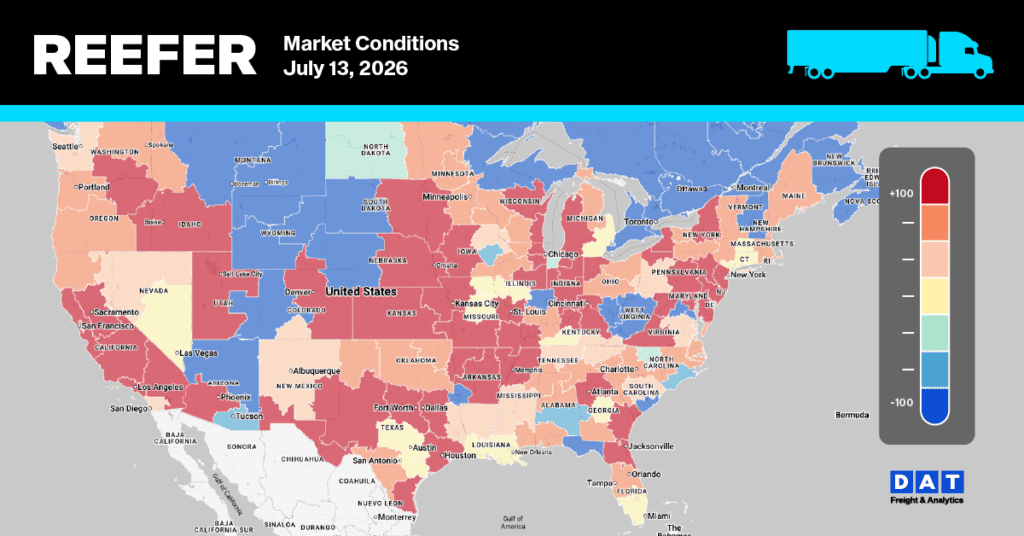
California truckload capacity flipped from loose to tight in a single week. Six districts — Imperial/Coachella, Kern, Oxnard, Salinas-Watsonville, Santa Maria, and South & Central — all moved off Adequate availability into Slight Shortage simultaneously on flat volumes year-over-year. Yakima Valley did the same. That’s the broadest one-week tightening move we’ve tracked this season, and it hit Northeast-bound lanes hardest: Boston, New York, and Baltimore posted the sharpest increases across nearly every California origin, while West Coast-facing lanes (Seattle, Los Angeles) mostly softened or held flat.
Mexico Crossings through South Texas also flipped — from Slight Surplus to Slight Shortage of trucks — though rates there haven’t moved yet, a gap worth watching. Georgia (which folds in West and North Florida) is the outlier, posting a second straight week of rate declines even though its Shortage designation hasn’t budged.
California: Six districts tighten at once
Imperial/Coachella Valleys CA, Central & Western AZ, Mexico Crossings (Calexico/San Luis)
The widest commodity mix in the report — anise, artichokes, blackberries, blueberries, broccoli, brussels sprouts, cabbage, cauliflower, celery, greens, kale, lettuce (green leaf, iceberg, red leaf, romaine), parsley, raspberries, and spinach — swung from Adequate to Slight Shortage, and Northeast rates moved with it. Boston posted the single biggest jump in the entire report.
Two-week arc: Boston has run from $11,300–$12,200 (July 7) to $13,900–$14,400 (July 14) — a sharp cumulative build after last week’s decline. New York shows the same pattern, climbing from $10,900–$11,400 to $12,600–$13,400.
Santa Maria CA
Also flipped to Slight Shortage. Broccoli, cauliflower, celery, lettuce (green leaf, iceberg, red leaf, romaine), and strawberries rebounded hard after last week’s broad pullback.
Two-week arc: Boston has gone from $10,900–$11,600 (July 7) to $12,700–$13,300 (July 14) — a full rebound of the prior week’s drop, not just a partial recovery.
Oxnard District CA
Celery, cilantro, greens, kale, parsley, and strawberries — also tightened to Slight Shortage. Two-week arc: Philadelphia has climbed from $10,700–$11,200 to $12,100–$13,000.
Kern District CA
Carrots only, but the tightening shows up clearly on the Northeast lanes. Two-week arc: New York carrots have moved from $10,500–$11,100 to $12,000–$12,800.
Salinas-Watsonville CA
Broccoli, cauliflower, lettuce (Boston, green leaf, iceberg, red leaf, romaine), and strawberries — the most stable of the six California districts this week, with modest upward drift rather than a spike.
South & Central district CA
Two separate commodity groups here, and they diverged. The mixed-vegetable basket (anise, artichokes, avocados, broccoli, cabbage, cauliflower, celery, kale, radishes, spinach, etc.) flipped from Adequate to Slight Shortage this week. The citrus basket (grapefruit, lemons, oranges) was already at Slight Shortage last week and held there — consistent with the ongoing transition out of navel oranges (closing out around the July 4 mark, per the seasonal window we track) into Valencias and lemons; this is a report-level status observation, not a confirmed volume trend yet.
Georgia (includes West & North Florida)
Notable structural point first: there is no standalone Florida line in this week’s or last week’s report — Florida volume is folded entirely into the Georgia district. That’s consistent with Florida’s spring/summer season having wound down; what’s left is riding on Georgia’s tomato and watermelon volume.
Tomatoes (regular, cherry, grape, plum) and watermelons stayed at Shortage for a second straight week — but rates kept sliding, which is the real story here: tight truck availability didn’t stop rates from falling.
Two-week arc: this is the second consecutive week of declines across nearly every lane — Atlanta has slid from $1,500–$1,700 to $1,300–$1,500, New York from $5,400–$5,600 to $4,700–$4,900. The capacity Shortage designation hasn’t changed either week.
Mexico crossings through South Texas
The other big availability move this week: South Texas flipped from Slight Surplus to Slight Shortage of trucks — the first shift off “surplus” territory we’ve seen in this district. Rates, however, barely moved, which means the tightening hasn’t shown up in price yet.
Commodities: asparagus, broccoli, carrots, chayote, cilantro, cucumbers, grapefruit, limes, oranges, papaya, peppers (Anaheim, bell, habanero, jalapeño, poblano, serrano), pineapples, tomatillos, tomatoes (grape, plum), and watermelons.
This is the first hard data point in the South Texas absorption story — the district’s availability status is tightening even though rates haven’t caught up. Worth watching next week to see if price follows status.
Yakima Valley & Wenatchee District, Washington
Peak cherry season pushed this district from Adequate to Slight Shortage. Apples, blueberries, cherries, pears, and rhubarb all riding the same capacity crunch, with the firming concentrated on Baltimore, Boston, and Los Angeles.
Vidalia District, Georgia
Availability held at Adequate for a third straight week, but rates turned. After a completely flat week (June 30 → July 7), nearly every lane firmed this week — still squarely inside the pack window we’re tracking.
Mexico crossings through Nogales, Arizona
The quiet corner of the report. Mangoes only, Adequate availability, and dead flat for a second straight week.
What this means for carriers, shippers & brokers
Carriers: Capacity out of California and Yakima just got tighter across the board — leverage is shifting your way on outbound loads from these origins, especially into Boston, New York, and Baltimore, where rates moved the most. Book aggressively into those Northeast lanes while the tightening holds.
Shippers: Budget for higher freight costs out of California this week, particularly on Northeast-bound moves. If you’re sourcing out of South & Central CA citrus or the mixed-vegetable basket, lock in coverage now — six districts tightening in the same week isn’t something we’ve seen this season, and it may not unwind quickly.
Brokers: Reprice contracted Northeast lanes out of California before renewal — margins are exposed if you’re still quoting off last week’s Adequate-availability numbers. The South Texas flip to Slight Shortage is early and rate-unconfirmed — don’t get ahead of it.