The early forecasts for the 2026 Atlantic hurricane season are pointing toward a near-average or slightly below-average year for storm activity, but that doesn’t mean trucking fleets can relax. Meteorologists believe a developing El Niño weather pattern could reduce the total number of storms by increasing wind shear across the Atlantic. Even so, forecasters continue to warn that unusually warm ocean temperatures in the Gulf and Atlantic could still fuel rapid storm intensification near the U.S. coastline. For trucking companies, fewer storms does not necessarily mean lower disruption risk.
Get the clearest, most accurate view of the truckload marketplace with data from DAT iQ.
Tune into DAT iQ Live, live on YouTube or LinkedIn, 10am ET every Tuesday.
The latest forecasts from major weather agencies are calling for anywhere from 11 to 16 named storms during the 2026 Atlantic hurricane season, including roughly 4 to 7 hurricanes and 2 to 4 major hurricanes classified as Category 3 or stronger. Colorado State University is forecasting 13 named storms, 6 hurricanes, and 2 major hurricanes, slightly below the long-term historical average of 14 named storms, 7 hurricanes, and 3 major hurricanes. AccuWeather is also warning that despite a lower overall storm count, the industry should still expect 3 to 5 direct impacts to the United States this year, particularly along the northern Gulf Coast, the northeastern Gulf, and the Carolinas.
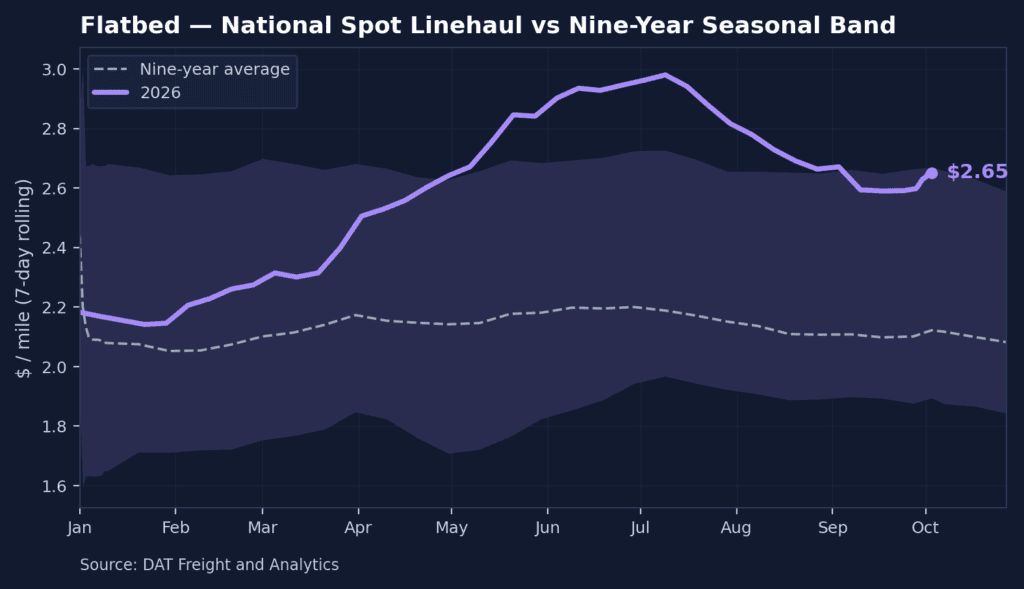
National flatbed spot rate trends
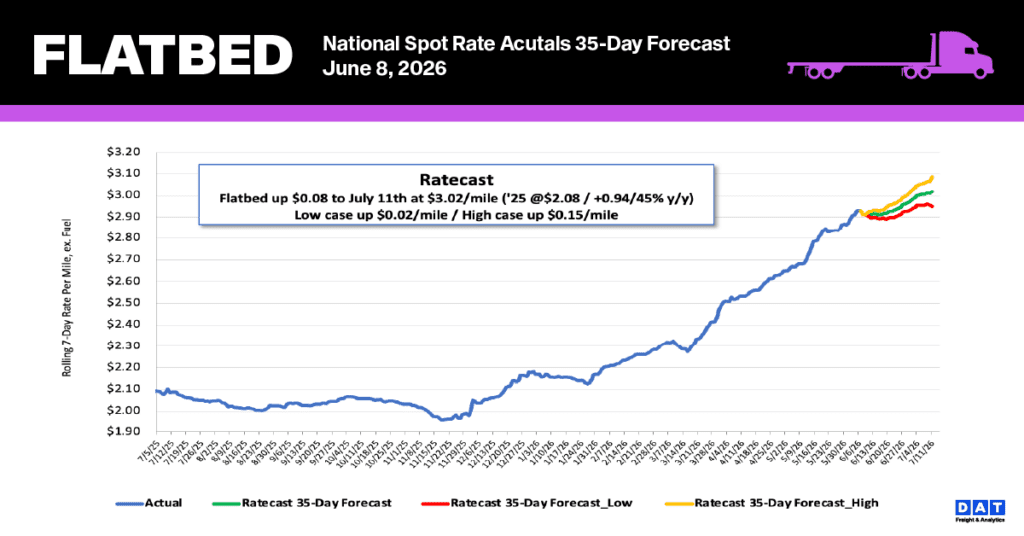
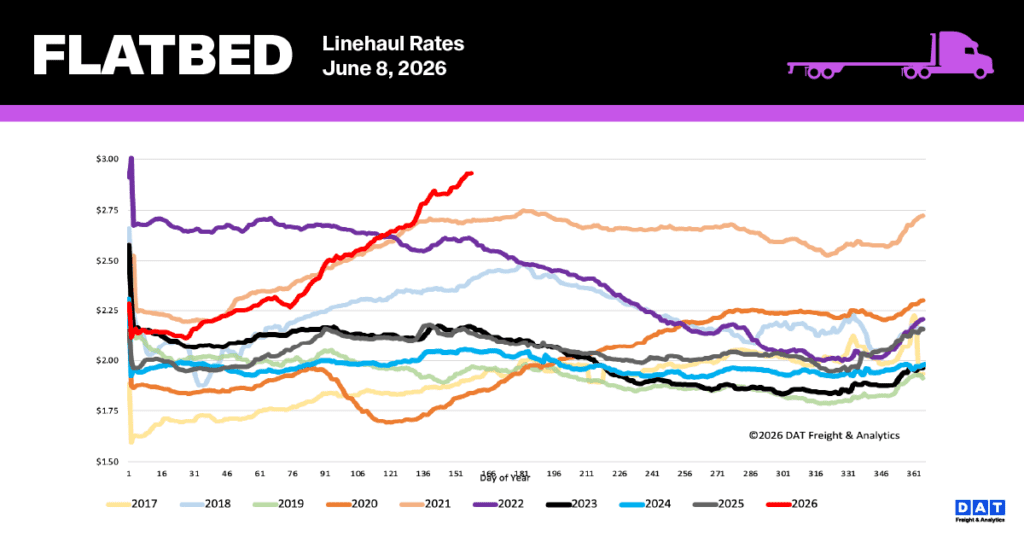
National flatbed spot rates reached a fresh high of $2.93 per mile last week, climbing $0.04 from the previous week due to ongoing capacity shortages. This milestone follows twelve consecutive weeks of expansion, during which rates jumped 25% ($0.61 per mile) to surpass the June 2021 historical peak by $0.18.
Market pricing continues to significantly outpace historical norms, remaining 37% ($0.79) higher than the previous year and 31% ($0.91) above the five-year average when excluding pandemic-related fluctuations. These unprecedented levels highlight the persistent tightening of flatbed capacity as reflected in the national 7-day rolling average.
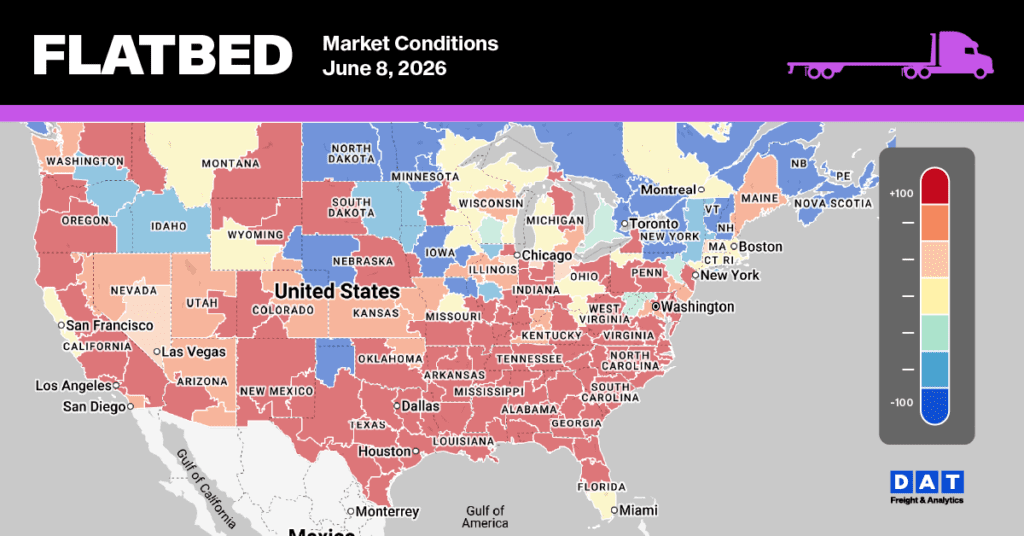
Flatbed Market Conditions
As the flatbed sector nears the end of its peak season, capacity continues to constrict. Total load postings have surged, climbing 76% compared to last year and tracking 32% above the long-term historical average (excluding the pandemic years of 2021 and 2022). Despite this robust demand, shifting supply-demand dynamics resulted in an 8% weekly decline for the flatbed load-to-truck ratio, which closed the period at 69.26.