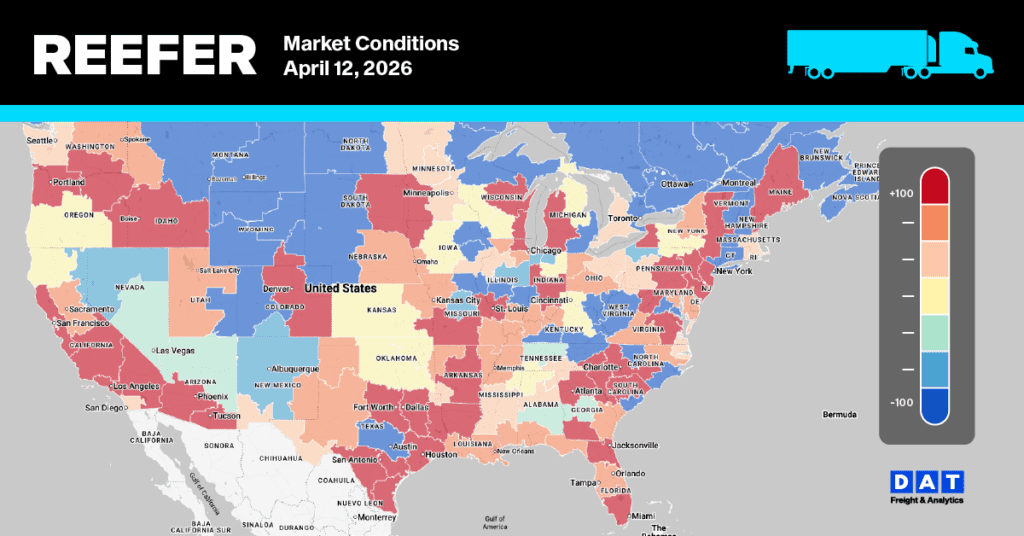
The spring transition just hit the produce freight map. Salinas-Watsonville appeared in the USDA report for the first time this season — marking the official start of the Yuma-to-Salinas lettuce shift we’ve been watching for weeks. Yakima Valley exploded with the largest rate moves of 2026 (+42% to Chicago, +38% to Dallas), Nogales cooled dramatically from last week’s Shortage back to all-Adequate, California citrus returned to the report at Slight Shortage, and Florida gave back last week’s double-digit gains. The map is reshuffling fast.
Get the clearest, most accurate view of the truckload marketplace with data from DAT iQ.
Tune into DAT iQ Live, live on YouTube or LinkedIn, 10am ET every Tuesday.
Yakima Valley posted the biggest moves of the year. Washington apples and pears surged on every lane — Chicago +42% to $6,500–$7,000, Dallas +38% to $6,900–$7,400, LA +20% to $2,500–$2,800, Seattle +10%, Baltimore +8%, Boston +7%. All ten lanes remain at Slight Shortage. Apple storage is drawing down hard as the season nears its end, and carriers with PNW capacity are in the driver’s seat.
Salinas-Watsonville opened at Slight Shortage with first-report rates to Baltimore at $9,200–$9,800 and Philadelphia at $9,400–$10,000 on broccoli, cauliflower, lettuce (Boston, green leaf, iceberg, red leaf, romaine), and strawberries. The Philly lane touching $10,000 out of the gate signals tight Central Coast capacity from day one. This is the seasonal inflection point that will reshape California reefer allocation through summer.
Nogales reversed from Shortage to Adequate on every lane after last week’s aggressive tightening. Rates reset to new baselines: Boston $9,500–$9,700, New York $9,200–$9,400, Philadelphia $8,900–$9,100, Atlanta $5,900–$6,200, Chicago $5,300–$5,600 on green beans, cucumbers, eggplant, honeydews, squash, tomatoes, and watermelons.
California citrus (blood oranges, grapefruit, lemons, oranges, tangelos) reappeared as a separate line at Slight Shortage on all nine destinations with rates resetting — Boston and New York at $9,200–$9,800, Miami $8,900–$9,500, easing from full Shortage two weeks ago.
California produce lanes held at Slight Shortage with South/Central CA to Baltimore jumping +8% to $9,000–$9,600 and Oxnard to Philadelphia up +4%.
South Texas held steady for its fourth consecutive week of all-Slight Shortage — rates moved just +1–2% on most lanes, confirming the ceiling pattern.
Florida gave back last week’s gains, with rates down -2% to -8% across all six lanes on beans, peppers, strawberries, tomatoes, and squash. Atlanta slipped back to $1,100–$1,300 (-8%), New York and Chicago both -8%. The one-week-up, one-week-down pattern continues — Florida remains range-bound with a shrinking post-freeze load pool. Colorado potatoes and New York apples remain Adequate and unchanged.
The complete produce wrap can be found here or at DAT.com/blog
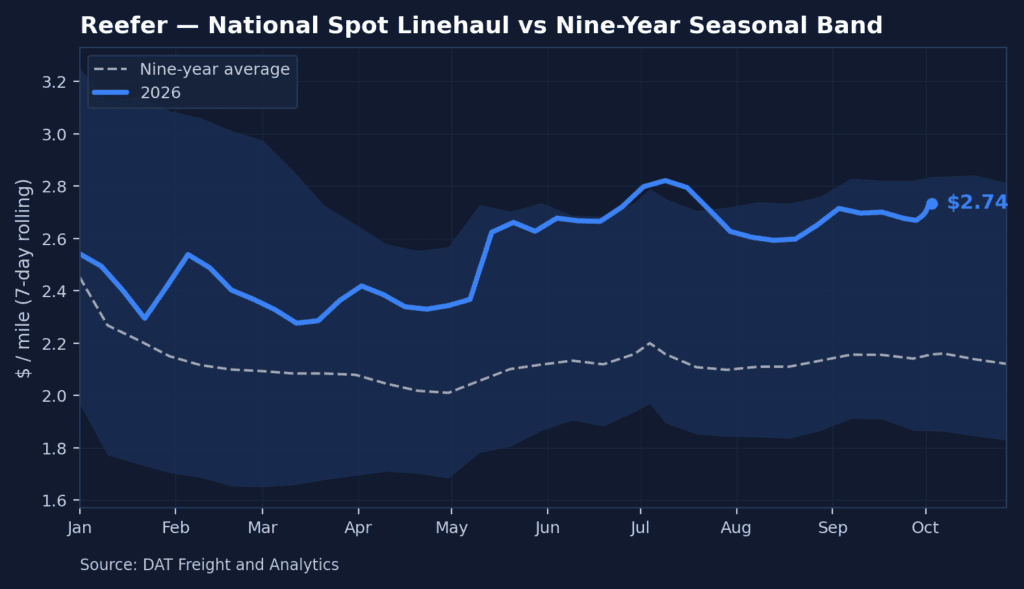
National reefer linehaul spot rates
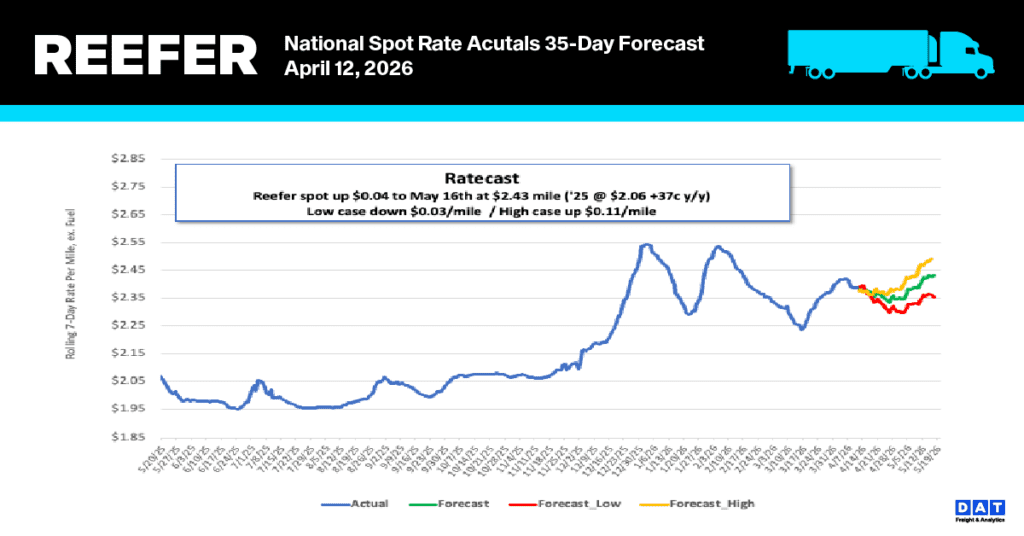
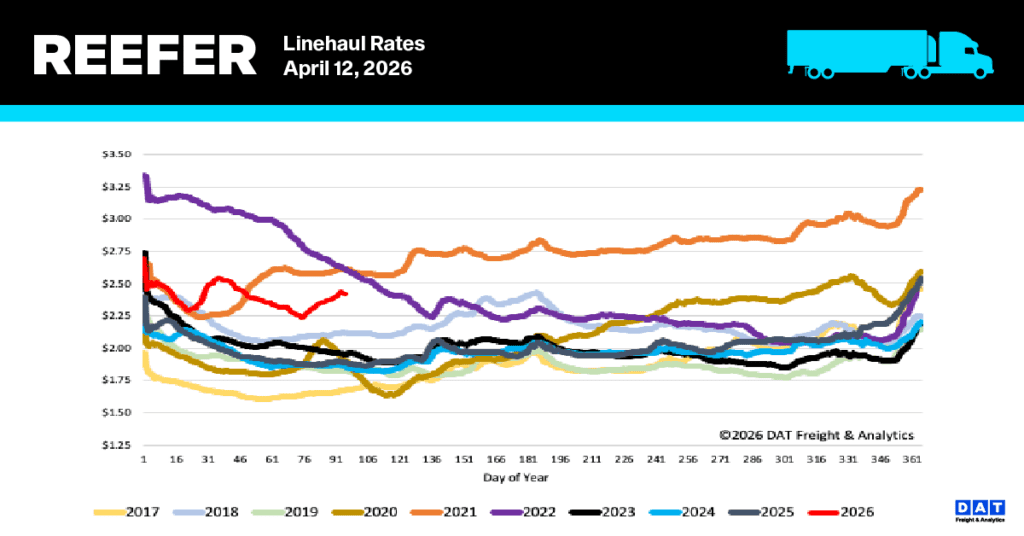
After three weeks of consecutive gains totaling $0.12, reefer linehaul rates saw a $0.04 per mile decline this past week, settling at an average of $2.39 per mile. Despite this recent dip, reefer rates remain substantially elevated compared to previous years. They are currently $0.51 (27%) higher than last year’s rate and $0.54 (23%) above the five-year average, excluding the unusual high-rate periods of 2021 and 2022.
Reefer Market Conditions
The reefer market saw a significant weekly drop, with the load-to-truck ratio falling 13% to 14.04. This decrease was primarily driven by a 19% reduction in load post volume. However, even with this decline, current load volumes are still more than 63% higher compared to the same time last year. Reflecting the general tightening of truckload capacity, equipment posts also declined last week, down 7%.